The text of the sixteenth century, with the sixteenth-century apparatus
1. The manuscript and the edition
Parisinus Graecus 450
The Quaestiones survive in a single medieval witness. Parisinus Graecus 450 was completed on 11 September 1364 in the milieu of the emperor John VI Cantacuzenus, and it is uniquely precious for a reason that has nothing to do with our text: it is the only medieval copy of the three genuine works of Justin Martyr — the two Apologies and the Dialogue with Trypho. These it transmits surrounded by a corpus of spurious writings, the whole attributed to Justin. The Quaestiones stand at fos. 334ʳ–416ʳ.
Its scribe was working from an older exemplar that was already damaged, and he recorded that damage rather than papering over it: where his model failed, he left blank space. The gaps in this manuscript are thus a mark of fidelity, not of carelessness — a verdict that reverses Harnack’s, and one on which the reading of Q. 107 turns.¹
From Venice to Fontainebleau
The codex surfaced in Venice in the mid-sixteenth century and was acquired there in 1540 by Guillaume Pellicier, ambassador of Francis I, who reported the find with evident excitement — j’ay recouvert ce bon monument d’antiquité de Justinus philosophus et martir — and despatched it to the royal library at Fontainebleau, whence it passed to the Bibliothèque nationale. Before letting it go he had a copy made for his own library, now London, BL Add. 82951; a second Venetian apograph, Oxford, Bodleian, Canonici gr. 61, comes from the same circle.²
Estienne, 1551
Robert Estienne announced the publication in his preface to the Biblia Regia of 1550. The book appeared the following year, set in the grecs du roi, the royal Greek types cut by Claude Garamond, and it was among the last works Estienne signed at Paris before leaving for Geneva.³
What he printed was, in substance, the whole of Parisinus 450. He added a few critical notes at the end of the volume; he occasionally admitted a marginal correction of the manuscript into his main text, noting the fact briefly at the back; and — most characteristically for our purposes — he marked the blank lines of the manuscript with asterisks.⁴
For Q. 107 one point follows, and it is worth stating plainly because the whole apparatus below depends on it. Parisinus 450 was the only copy of this work Estienne had. There was no second manuscript to collate and nothing to contaminate the text with. (Elsewhere in the volume he did draw silently on other codices — he restored readings of Par. 1268 in many places of the Expositio rectae fidei, and sometimes of Par. 451 in the Epistula ad Zenam et Serenum, tacite in both cases — but that possibility does not arise here.)⁵ Estienne’s editorial intervention in Q. 107 is confined to a single act: marking, with an asterisk, the point at which his manuscript failed him.
The asterisk is therefore not an editor’s judgement about the text. It is a report, at one remove, of a physical gap: the printer records a blank in the manuscript, and the manuscript records damage in its exemplar. When Sylburg later fills that gap by conjecture, and later editors after him, they are supplying something that no witness in this line ever had.
The manuscript checked
This can be verified directly, and has been. Q. 107 stands on two facing openings of the codex.⁶
On fol. 389ʳ, in the lower right column, Q. 106 closes with ἄλλοις δὲ λόγος γνώσεως; there follows the rubric ΕΡΩΤΗCΙC ΡΖ in majuscule, the question in full, the rubric ΑΠΟΚΡΙCΙC, and the answer as far as καὶ μετὰ ὀρχήσεως καὶ κροτάλων· διὸ ἐν ταῖς ἐκκλησίαις, where the page ends.
On fol. 390ʳ, in the left column, the answer runs on to ῥῆμα γάρ ἐστι θ(εο)ῦ — with the nomen sacrum — τὸ καὶ ἐνθυμούμενον καὶ ἀδόμενον καὶ ἀνακρουόμενον· δαιμόνων γίνεται ἀπελατικόν. And then the scribe does not begin the next line at the margin. He leaves white space several words wide, and only after it writes τα, τελειωτικὰ τῆς ψυχῆς ἐν ταῖς κατ᾽ εὐσέβειαν ἀρεταῖς. The rubric ΕΡΩΤΗCΙC ΡΗ follows.
The chain is therefore complete and visible at every link:
damaged exemplar → the scribe of 1364 leaves a blank → Estienne sets an asterisk in a wide space, 1551 → Sylburg sets a row of points, 1593
Three witnesses, one physical gap, and not one of them fills it. What was inferred above from the character of the manuscript can be read off the page.
Diffusion
The edition became one of the publishing events of the century and carried a newly available corpus across Europe; it fed at once into the confessional controversies of the period, including the Protestant debate over church music that turns on Q. 107.⁷ A French translation followed in 1554 (Jean de Maumont), and three independent Latin versions — Joachim Périon (1554), Sigismund Gelenius (1555), and Johannes Lang (1565), who completed what Gelenius had left unfinished at his death.
So the position is simple, and it is the premise of everything that follows: there was one Greek text, made from one manuscript, and every sixteenth- and seventeenth-century reader of Q. 107 worked from it or from a version made out of it.
Sylburg’s reprint, 1593
Otto’s account of what happened next is unambiguous:⁸ Illam editionem principem additis Io. Langi versione et aliquot virorum doctorum symbolis Heidelbergae a. 1593 Fridericus Sylburgius iteravit — Sylburg repeated the editio princeps at Heidelberg, adding Lang’s Latin version and the contributions of several learned men. For Q. 107 this has been checked. Sylburg reproduces the lacuna with a row of points where Estienne sets an asterisk; that is the only difference found. His Greek therefore carries no siglum of its own. What is his, and what is new in 1593, is the annotation — two layers of it — together with the Latin version he took over from Lang.
The reprints
Sylburg’s edition was itself reprinted, and the reprints matter for reception. Federicus Morellus reissued it at Paris in 1615 sine ulla fere mutatione, with almost no change, and again in 1636; a further Cologne reprint of 1686 Otto calls vitiose, faulty.⁸ A seventeenth-century writer citing “Sylburg” may well be citing Morel, and one citing the Cologne text is citing a degraded one.
¹ P. Toth, “New Questions on Old Answers: Towards a Critical Edition of the Answers to the Orthodox of Pseudo-Justin,” Journal of Theological Studies 65 (2014), 550–599, at pp. 558, 561 — where the manuscript is credited as a diligent copy of an old and respectable, if damaged, exemplar, against Harnack’s verdict on the scribe.
² Toth 2014, pp. 561–563, on Pellicier’s acquisition and the two apographs; O¹ (Canonici 61) reproduces the lacunae of Parisinus 450 by repeating the same blank lines, which is what proves its descent.
³ Elizabeth Armstrong, Robert Estienne, Royal Printer: An Historical Study of the Elder Stephanus (Cambridge: Cambridge University Press, 1954), p. 138; A. Wartelle, Bibliographie historique et critique de saint Justin … 1494–1994 (Paris, 2001).
⁴ Toth 2014, p. 564, with the example of Q. 58, where the first hand’s reading was corrected in the margin of the manuscript and Estienne printed the marginal form in his text with a short remark at the end of the volume.
⁵ J. C. T. von Otto, Iustini philosophi et martyris opera quae feruntur omnia, vol. 3/2 (Corpus apologetarum christianorum saeculi secundi V), 3rd edn (Jena: Mauke, 1881), Prolegomena, p. XXXVII. Otto’s edition is cited repeatedly below and its standing should be stated once. It is the first genuinely critical edition of the Quaestiones and still the most recent complete one: Otto collated all his predecessors, was the first to bring manuscripts other than Parisinus 450 and its apographs into the apparatus, and set out in his Prolegomena a bibliographical account of the manuscripts and of every printed edition from 1551 onward. His constituted text is used here only as a means of access — he records, at each place where he departs from the printed tradition, what omnes editiones read — and his Prolegomena are used as testimony about the editions themselves. On what his sigla stand for, and on the limits of this procedure, see §6.
⁶ Paris, Bibliothèque nationale de France, Département des manuscrits, Grec 450, fols. 389ʳ and 390ʳ, from the digitised copy. The readings quoted here are word-forms read at page scale; the three places in Q. 107 that turn on a single letter — περι‑/προ‑, τὸ/ὃ, ἡδομένου/ᾀδομένου — have not been examined at magnification. They are in any case reported by Otto, whose siglum C is this manuscript.
⁷ Toth 2014, pp. 564–566. Toth also notes a consequence worth registering: the printed text was so authoritative that it flowed back into manuscripts, so that early-modern copies carry the editors’ conjectures and even Estienne’s marks — a second, early-modern stratum of the tradition.
⁸ Otto, Prolegomena, p. XXXVIII, where the whole sequence of reprints is set out.
2. Parallel text
Greek as Estienne printed it in 1551 and Sylburg reprinted it in 1593. On how the text has been established, see §6.
Ἐρώτησις ρζ´ — Question 107
| Greek | English |
|---|---|
| Εἰ ὑπὸ τῶν ἀπίστων πρὸς ἀπάτην εὑρέθη τὰ ᾄσματα, τοῖς δὲ ἐν νόμῳ εἰσηγήθη διὰ φρενῶν νηπιότητα, | If songs were devised by unbelievers for the purpose of deception, and were introduced among those under the Law on account of childishness of understanding, |
| οἱ τῆς χάριτος τέλεια καὶ τῶν ῥηθέντων τρόπων ἀλλότρια παρειληφότες μαθήματα διὰ τί ἐν ταῖς ἐκκλησίαις κατὰ τοὺς ἐν τῷ νόμῳ νηπίους τοῖς ᾄσμασι κέχρηνται; | then why do those who have received the teachings of grace — teachings that are perfect, and foreign to the practices just described — make use of songs in the churches, after the manner of the childish under the Law? |
Ἀπόκρισις — Answer
| Greek | English |
|---|---|
| Οὐ τὸ ᾆσαι ἁπλῶς ἐστι τοῖς νηπίοις ἁρμόδιον, ἀλλὰ τὸ μετὰ τῶν ἀψύχων ὀργάνων ᾆσαι καὶ μετὰ ὀρχήσεως καὶ κροτάλων· | It was not singing by itself that suited the childish, but singing with lifeless instruments, and with dancing and rattles. |
| διὸ ἐν ταῖς ἐκκλησίαις προαίρεται¹ ἐκ τῶν ᾀσμάτων ἡ χρῆσις τῶν τοιούτων ὀργάνων καὶ τῶν ἄλλων, τῶν νηπίοις ὄντων ἁρμοδίων, καὶ ὑπολέλειπται τὸ ᾆσαι ἁπλῶς. | This is why, in the churches, the use of such instruments has been taken away from the songs, together with the other things that suit the childish, and singing by itself has been left remaining. |
| Ἡδύνει γὰρ τὴν ψυχὴν πρὸς ζέοντα πόθον τοῦ ἐν τοῖς ᾄσμασιν ἡδομένου², κοιμίζει τὰ ἐκ τῆς σαρκὸς ἐπανιστάμενα πάθη, | For it sweetens the soul into a seething longing for that which is its delight in the songs; it lulls to sleep the passions that rise in revolt out of the flesh; |
| τοὺς ὑπὸ τῶν ἀοράτων ἐχθρῶν ἐμβαλλομένους ἡμῖν λογισμοὺς πονηροὺς ἀπωθεῖται, ἀρδεύει τὴν ψυχὴν πρὸς καρποφορίαν θείων ἀγαθῶν, | it thrusts away the wicked thoughts that the unseen enemies hurl into us; it waters the soul to the bearing of divine fruits; |
| γενναίους πρὸς τὴν ἐν τοῖς δεινοῖς καρτερίαν τοὺς ἀγωνιστὰς ἐργάζεται τῆς εὐσεβείας, πάντων τῶν ἐν τοῖς βιωτικοῖς λυπηρῶν ἰαματικὸν γίνεται τοῖς εὐσεβέσι. | it makes the contenders of piety noble for endurance in the midst of terrors; it becomes for the pious a healing remedy for every grief of daily life. |
| Μάχαιραν τοῦ πνεύματος τοῦτο ὁ Παῦλος ὀνομάζει, ἐν ᾧ κατὰ τῶν ἀοράτων πολεμίων ὁπλίζει τοὺς ὁπλίτας τῆς εὐσεβείας· | Paul names this the sword of the Spirit, by which he arms the armed men of piety against the unseen adversaries. |
| ῥῆμα γάρ ἐστι θεοῦ τὸ³ καὶ ἐνθυμούμενον καὶ ᾀδόμενον καὶ ἀνακρουόμενον⁴ δαιμόνων γίνεται ἀπελατικόν. | For the word of God is that which — pondered in the mind, and sung, and struck up — comes to have the power of driving demons away. |
| ✻⁵ τα τελειωτικὰ τῆς ψυχῆς ἐν ταῖς κατ᾽ εὐσέβειαν ἀρεταῖς, διὰ τῶν ᾀσμάτων τῶν ἐκκλησιαστικῶν τοῖς εὐσεβέσι προσγινόμενα. | ⟨…⟩ perfective of the soul in the virtues that accord with piety, accruing to the pious through the songs of the church. |
The asterisk is Estienne’s own, printed in a wide blank; Sylburg reproduces the break with a row of points. The text resumes mid-word at ‑τα.
3. Apparatus: the sixteenth century
Only sixteenth-century material is recorded here. Later conjectures — Maran’s, Buhl’s, Otto’s — belong to the afterlife of the text, not to what its early readers had, and are treated separately.
Sigla of the annotators. Sylburg’s Annotationes cite by initial. V. and A. recur throughout; P. is Perionius. On V. see note 1. A. is very probably Johannes Arcerius, who is named in full at Annot. p. 429 in a note where the same reading is discussed. These expansions are inferred from Sylburg’s usage; his own list of abbreviations has not been consulted and should be.
Sy¹ — Sylburg, Annotationes, 1593, pp. 429, 450. Sy² — Sylburg, Annotationes posteriores, 1593, p. 443. Same volume, continuous pagination; not a later publication.
1. προαίρεται — the reading of both editions, verified on the pages.
Sylburg, Annot. p. 430 ad p. 358 v. 1: V. παρῄρηται, recte — and he gives the sense in Latin: quamobrem etiam in ecclesiis usus talium instrumentorum et ceterorum quae infantibus conveniunt, e cantionibus sublatus est, “which is why in the churches, too, the use of such instruments and of the other things that suit infants has been removed from the songs.”
So a difficulty was seen here in the sixteenth century, and V.’s remedy was endorsed by Sylburg. What no one disputed was the sense: removal.
Who is V.? Hieronymus Wolf (1516–1580) — Otto’s identification, and it stands. Wolf was a pupil of Melanchthon and Camerarius who became secretary and librarian of the Augsburg city library in 1537, of the Fugger library in 1551, and first rector of what became the St Anna Gymnasium; he is remembered as the founder of German Byzantine studies. He had one of the richest collections of Greek manuscripts in Europe at his elbow and worked all his life as an editor of Greek texts. The siglum
V.for a man called Wolf is not an obstacle: W had no place in the Latin alphabet and was set as VV, so Wolf appears in Latin as Vuolfius or Volfius.Wolf died in 1580, thirteen years before Sylburg’s edition, so his readings reached Sylburg posthumously. The likeliest route runs through David Hoeschel (1556–1617), who was Wolf’s pupil, succeeded to his rectorship at the St Anna Gymnasium in Augsburg, and is named in the catalogue description of the 1593 edition — alongside Arcerius — as one of the scholars whose notes Sylburg incorporated. These are Otto’s aliquot viri docti. That Wolf’s Justin emendations specifically travelled by this route is an inference from Hoeschel’s position and his presence in the volume, not a statement found in either source; Sylburg’s own preface would settle it.
2. ἡδομένου — the reading of both editions, verified on the pages.
Sylburg, Annot. p. 429 ad p. 358 v. 4: pro ἡδομένου idem V. reponit ὑμνούμενος — V. substitutes “hymned” — potest etiam minori mutatione legi ᾀδομένου, “it can also be read, with a smaller change, as ᾀδομένου,” sung.
Two sixteenth-century proposals, then, at one word: V.’s and Sylburg’s own. Sylburg presents his as the lighter change and does not press it. Both assume the same thing about the slot — that it should name what the songs are about — and the transmitted ἡδομένου resists that, because ἥδομαι is middle and denotes the one taking pleasure rather than the one delighted in. Against the emendations stands the figure of etymology: the clause opens ἡδύνει and closes ἡδομένου.
3. τὸ — the reading of the edition; ὃ conjectured by Sylburg, Sy¹.
The article is load-bearing for the syntax. With τὸ, the participial phrase is the predicate — the word of God is the thing that, pondered and sung and struck up, drives demons out. With Sylburg’s relative, the word of God is the subject and the three participles merely describe it: the triad becomes descriptive rather than definitional.
Sylburg prints the relative in his reconstruction of the damaged passage at Annot. p. 429, together with a raised point after Θεοῦ that carries the repunctuation the change requires: ῥῆμα γάρ ἐστι Θεοῦ· ὃ καὶ ἐνθυμούμενον…. It is therefore a sixteenth-century conjecture, and belongs in this apparatus. (Otto later printed ὃ and marked it Ego, his own.)
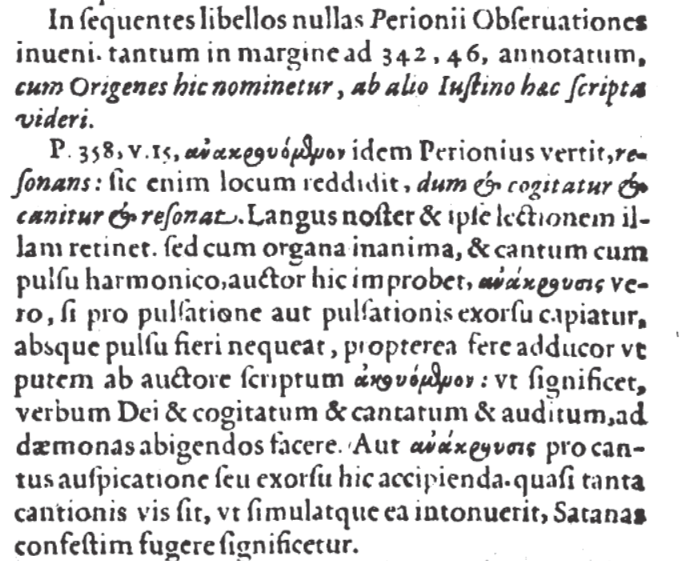
4. ἀνακρουόμενον — the reading of the edition, and the word the whole later argument turns on.
No sixteenth-century variant is reported for it, by anyone. What the sixteenth century produced instead was a spread of interpretations and, at the very end, one conjecture.
The Latin versions diverge. Périon (1554) rendered the triad dum et cogitatur et canitur et resonat — resounds, which decides nothing. Lang (1565), whose version Sylburg printed beside his Greek, rendered quod animi cogitatione, quod carminis praeludio, quod carmine ipso celebratur: the instrumental term is moved silently from third place to second and turned into a prelude. Sylburg’s own paraphrase in Annot. p. 429 restores the Greek order and reads the word instrumentally, quod et cogitatum, et cantatum, et pulsatum. Gelenius’s pulsu edatur and Maumont’s en preface are recorded in QRO_Q107_triad_renderings_16c.md and have not been re-verified here.
The conjecture, Sy². In the Annotationes posteriores, p. 443, Sylburg reconsiders. Because the author rejects lifeless instruments and singing to harmonic accompaniment, and because ἀνάκρουσις taken as pulsatio cannot occur without a striking, propterea fere adducor ut putem ab auctore scriptum ἀκουόμενον — “I am almost brought to think the author wrote ἀκουόμενον,” heard. He then immediately offers an alternative that keeps the transmitted word: ἀνάκρουσις as cantus auspicatio seu exorsus, the striking-up of a song, so powerful that Satan flees the moment it sounds.
The conjecture rests on no witness. It is argued from the sense of the passage alone, it is stated hesitantly, and it is half withdrawn in the same paragraph — landing on the reading that Lang’s Latin, printed under Sylburg’s own name in the same volume, had already given.
5. Lacuna after ἀπελατικόν.
Marked, not concealed: an asterisk in Estienne, a row of points in Sylburg.
Sylburg, Annot. p. 429 ad p. 358 v. 14, offers a supplement — sic ferme interpolari poterit locus — filling the gap with [καὶ ἁπαξαπλῶς γίνεται τὰ τοιαῦτα μελετήμα]τα, and glosses his own supplement into Latin: atque, ut uno verbo dicam, valent eiusmodi meditationes ad animam in verae pietatis virtutibus perficiendam. Lang’s Latin marks the same gap with square brackets in the translation.
4. Sylburg’s two layers
Both of Sylburg’s note-apparatuses are honoured by Otto, who cites them — but Otto’s notes compress them into one, and they are not one.
Sy¹, the Annotationes (pp. 429-430), belong with the edition. Here Sylburg reads ἀνακρουόμενον instrumentally (pulsatum), supplies the lacuna, and reports and endorses V.’s readings. He also names his sources: the annotations cite V., A., P. throughout, and he states elsewhere that he had manuscript material from the Palatine library before him.
Sy², the Annotationes posteriores (p. 443), are a supplement written after the first set was finished. Sylburg says so in their preface: he thought he had put the last hand to his notes when Marquard Freher told him of a chapter on Justin’s second Apology in the second book of Jacobus Billius’s Sacrarum Observationum. Going to the Electoral Library and reading Billius, he discovered that Périon had annotated Justin as well as translated him, and found himself with a new job of work. He transcribed Billius entire and excerpted Périon selectively.
For the Quaestiones specifically, however, he found almost nothing: In sequentes libellos nullas Perionii Observationes inveni — for the later booklets no Périon observations at all, apart from one marginal note at 342,46 remarking that since Origen is named here, the work seems to be by a different Justin. What Sylburg cites from Périon at the crux is therefore Périon’s translation, not his annotations.
Both layers are in the volume of 1593.
5. The sixteenth-century flags and the Athens witness
A pattern is worth recording, with a caution attached.
The places in Q. 107 where sixteenth-century scholars registered difficulty are few and identifiable: entries 1, 2, 3 and 5 above. Three of them can now be set against the independent tenth-century Athens manuscript (Athens, National Library, Metochion tou Panagiou Taphou 273), published by Papadopoulos-Kerameus in 1895 and unknown to all of these scholars. The results are not uniform, and that is what makes them useful.
| Sixteenth-century flag | Athens |
|---|---|
| 5. Lacuna after ἀπελατικόν, marked by asterisk; Sylburg supplies a clause | No lacuna: … ἀπελατικόν· ἅπερ ἐστὶν ἅπαντα τελειωτικὰ τῆς ψυχῆς … — the relative clause supplies exactly the missing connective |
| 1. προαίρεται; Wolf’s παρῄρηται, endorsed by Sylburg | περιαιρεῖται — a third solution, and neither of the two the sixteenth century reached for |
| 4. ἀνακρουόμενον; Sylburg’s conjecture ἀκουόμενον, argued from sense | ἀναγιγνωσκόμενον, “read aloud” — the instrument absent and no difficulty left to resolve |
| 2. ἡδομένου; Wolf’s ὑμνουμένου and Sylburg’s ᾀδομένου | ἡδομένου — Athens agrees with the editions |
Entry 2 is the control, and it is decisive for how the other three should be read. At ἡδομένου the two branches agree, so nothing had gone wrong with the text at all. Estienne printed what he had read: ἡδομένου, Sylburg reprints it. No conjecture is put into the line. Wolf’s ὑμνουμένου and Sylburg’s own ᾀδομένου live in the margin, offered and not imposed. Sixteenth-century unease (i.c. Wolf’s, then followed by Sylburg) is therefore not by itself evidence of corruption — but sixteenth-century reading is reliable, and the two must not be conflated.
The same division holds at the crux. ἀνακρουόμενον stands in the text of both editions, uncorrected; the doubt is confined to an annotation, and there it is stated hesitantly, tentatively, and in the end half withdrawn.
Entry 1 cuts the other way, and it is now the strongest case in the table. Estienne and Sylburg both print προαίρεται — the Paris branch is united — and Athens has περιαιρεῖται. The branches genuinely differ, so something did go wrong in transmission, and the sixteenth century put its finger on the exact spot without any means of knowing why. Athens moreover mends it in a way no early scholar proposed: neither Wolf’s παρῄρηται nor anything like it, but a third form. A reading that no conjecturer reached for is more likely to have been transmitted than devised, which is a point in favour of the Athens branch here and, by extension, at the lacuna.
The caution, which is the point. That a second branch reads smoothly where the first stumbles admits two explanations, and they point in opposite directions. Either Athens preserves what the Paris branch lost — and at the lacuna this is much the more economical account, since the loss is explicable as a mechanical slip after the similar opening ἀπ‑ / ἅπ‑, and the reading rests on a witness rather than on editorial invention — or Athens is a smoothed branch, in which an intelligent scribe or reviser removed the same difficulties that later scholars removed by conjecture. At the triad in particular, ἀναγιγνωσκόμενον does to the passage precisely what Maran’s ἀκουόμενον would later do: it abolishes the problem. That is what one expects of a good text, and equally of a tidied one.
Toth, who established the two-branch stemma, calls it tentative and defers a full assessment to the critical edition still in progress, and makes no claim that Athens is superior at Q. 107. Nothing here settles the question. What it does show is that these editors were reading accurately. Of the three places where they stopped and argued, two — entry 1 and the lacuna — are places where the tradition itself is demonstrably under strain; the third, ἡδομένου, is not, and there they emended a text that was sound. The reading was reliable; the impulse to mend was not.
And it leaves the reception argument untouched. Whatever the archetype read, ἀνακρουόμενον is what stood in the only text there was, and it is what Périon, Lang, Gesner and Praetorius had in front of them.
6. Provenance
The Greek is Otto’s constituted text with the readings of omn. edd. restored at his notes 4, 5, 8 and 10; nothing else has been altered. His notes 2 and 6 concern a manuscript, not available in the sixteenth century, and are not applied.
Estienne’s source (the only one available) has siglum C — Codex (Regius) Parisinus CDL, Paris gr. 450.
Sylburg’s annotations at entries 1, 2, 3, 4 and 5 are established from the page images of the 1593 edition, pp. 429–430, 443. His Greek text of Q. 107 is established from pp. 357–358 of the same volume.
This text thus reproduces what Estienne printed (and Sylburg reprinted) to the extent that Otto’s apparatus records it. One of the two gaps that method leaves has now been closed: Sylburg’s Greek has been collated against Estienne’s at every disputed point in Q. 107 and departs from it nowhere. The other remains — places where Otto passed over a difference in silence would still escape this text, and only a word-by-word collation of the 1551 page against Otto would exclude them.