A music story, unfolding backwards.
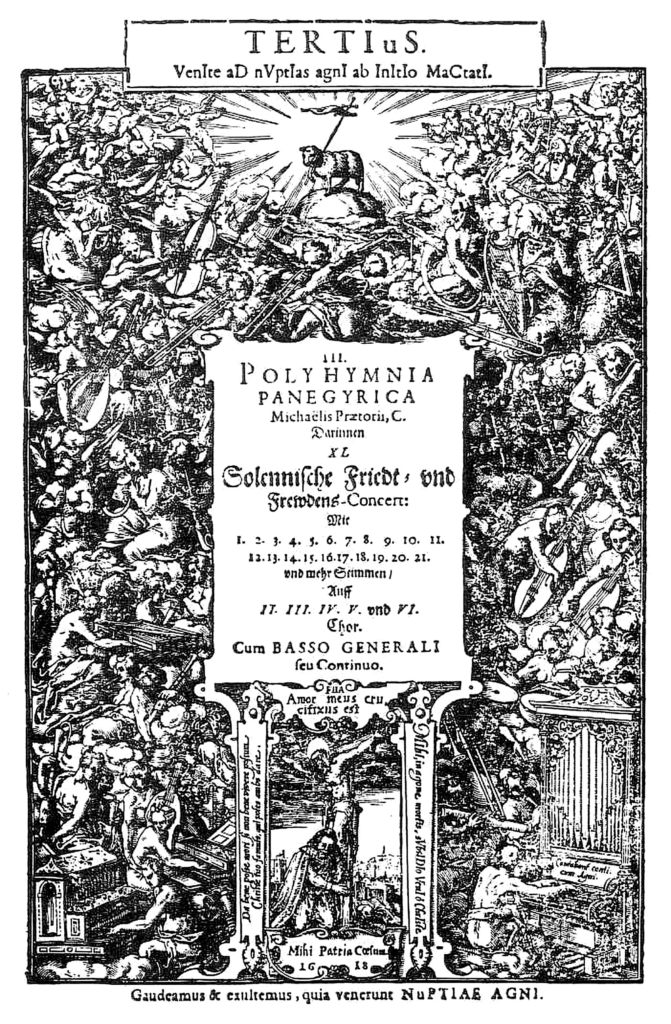
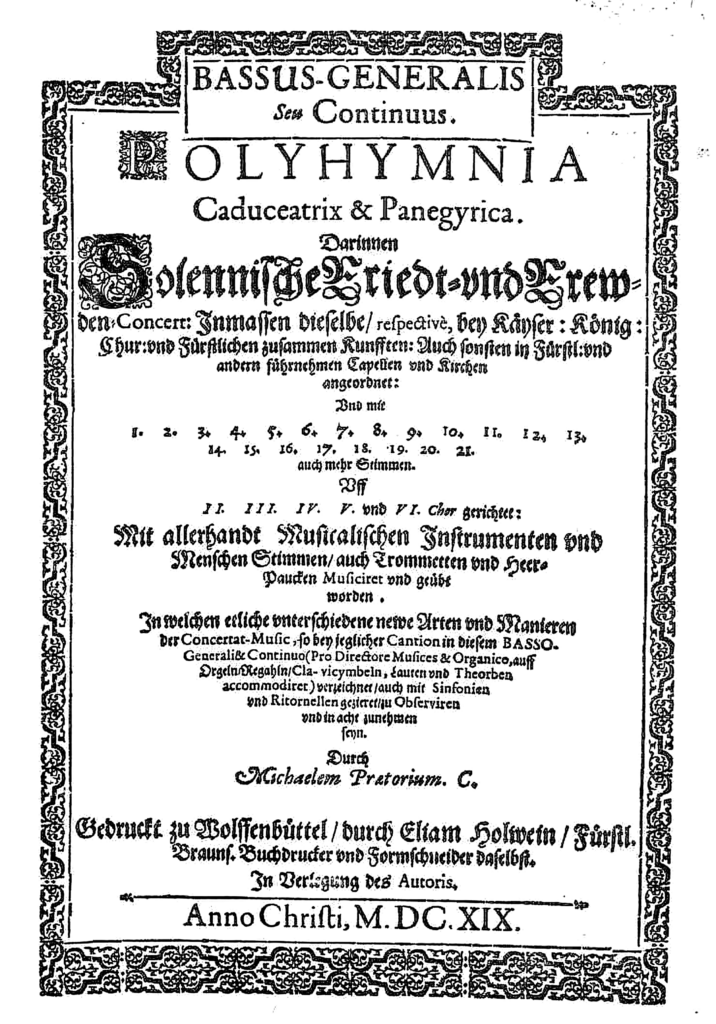
Praetorius’s problem: how to defend the use of instrumental music in worship?
At the start of the seventeenth century, Michael Praetorius (Hofkapellmeister in Wolffenbüttel) set out to defend the use of instruments in Lutheran worship — not just to support the singing (as we use them today, a practice not yet established then), but as liturgical music mode in its own right. Not a comfortable position to hold. The Reformed churches (Calvin-inspired) were of the opinion, that a congregation had nothing to bring before God but its own voices (vocal music, singing, unisono). And within Lutheranism there was unease as well. The use of chant and congregational hymns nobody disputed. But what about alternatim organ-playing (the organ ‘sings’ a verse while the congregation is silent, the german verb ‘orgeln’)? And what about those great polychoral pieces in which e.g. a cornett could take a line, or even a ‘choir of sackbuts’ answering the vocal choir?
Underneath these objections lay a theological issue, and on this point all confessions (incl. roman-catholics) largely agreed. The use of musical instruments to praise God belonged to ‘the old dispensation’. Israel under the Law — “not yet come of age’, infants, in the language of the period — had needed trumpets and cymbals and strings and psalters to give its faith something outward and physical to hold on to. Christians under the Gospel, owever, needed no such crutch. Theirs was a religion of the heart, not of the flesh. They sang with the living human voice, ‘praising God in their hearts’ (quoting St. Paul – Colossians/Ephesians), and nothing else. Nor was there help —for Praetorius— to be had from the patres, the church fathers. On instrumental music they were unusually severe and close to unanimous: it was pagan, or childish (remember ‘Israel’) , or both. That mattered, because patristic authority was not something either side of the protestant confessional divide could simply set aside. Neither argued from Scripture alone; both appealed also to the creeds, the dogmatic definitions, and the symbols of the ecumenical councils.
So the case Praetorius wanted to make for ‘instrumental music in worship’ was weak, and the sources that might have strengthened it all pointed the other way.
But then, thanks be to God, there was Justin. Question 107 of a collection of questions and answers passing under the name of Justin Martyr, the second-century philosopher and martyr — the Quaestiones et responsiones ad orthodoxos, “Questions and Answers for the Orthodox.” The question asnwered there, is exactly the one the whole tradition had settled: why do Christians still use music in their worship? And almost alone among the fathers, the answer that follows does not merely tolerate such instruments. It seems to lift them up, to make the sounding of an instrument one of the ways the Word of God is uttered in the world.
Or so, at least, the text appeared to say. That “appeared” is what this site is about. What did Praetorius say, and where did he read this phrase, this praise of instrumental music?
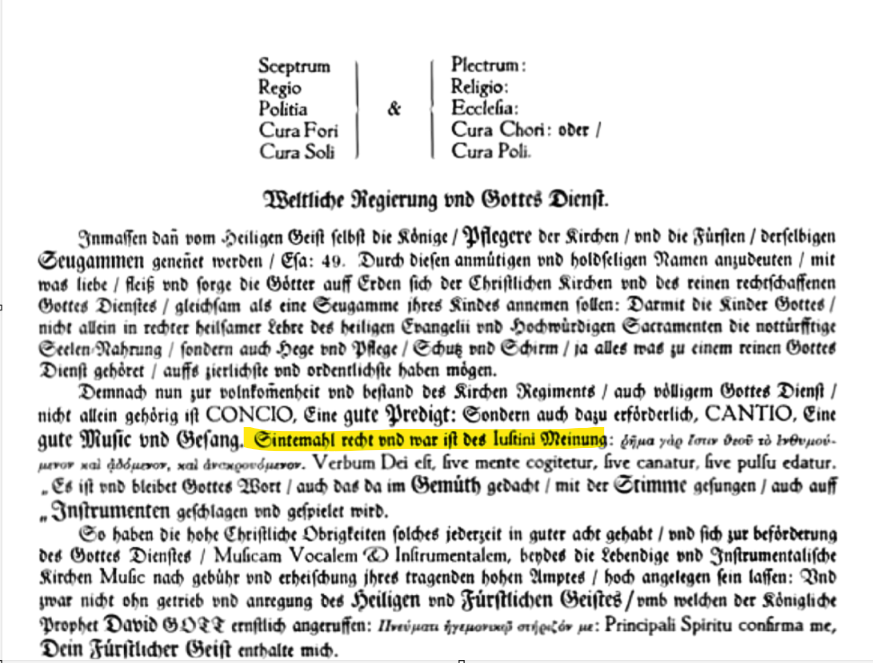
The quote:
Sintemahl recht vnd war ist des Iustini Meinung: ῥῆμα γάρ ἐστιν θεοῦ τὸ ἐνθυμούμενον καὶ ᾀδόμενον, καὶ ἀνακρουόμενον. Verbum Dei est, sive mente cogitetur, sive canatur, sive pulsu edatur.
“Es ist vnd bleibet Gottes Wort / auch das da im Gemüth gedacht / mit der Stimme gesungen / auch auff Instrumenten geschlagen vnd gespielet wird.”[“For Justin’s view is right and true: the Word of God, whether it is held in the mind, or sung, or struck out on an instrument. It is and remains God’s Word”]
This website traces how that single Greek word — ἀνακρουόμενον — came to carry such weight, and what happens when we follow it back through its sixteenth-century translators to the Greek text itself. Justin wrote in Greek, so his influence on this debate depended entirely on which Latin translation a given reader happened to have in hand. Below are four of those translations, juxtaposed, as the working material for that inquiry.
The key word: ἀνακρουόμενον
Justin wrote in Greek, and for most sixteenth-century readers — clergy, theologians, musicians — Greek was not available, what travelled was Latin. Between 1554 and 1593, four Latin versions of Question 107 appeared in succession, each produced by a scholar reckoning independently with the same verb, ἀνακρουόμενον.
- Joachim Périon (1554) rendered it with the neutral resonat, “it resounds.”
- Sigismund Gelenius (1555) went further, choosing the frankly instrumental pulsatur, “is struck.”
- Johannes Lang (1565) read it instead as a musical prelude, carminis praeludio.
- Friedrich Sylburg (1593), reissuing Lang’s Latin alongside a newly edited Greek text, kept praeludio but flagged the instrumental reading in his apparatus.
And —surprise— the very first translation that appeared was not a Latin one, but a vernacular: A translation into French by Ian de Maumont (1554, revised 1559).
- Maumont (1554): chantee … en preface
- Maumont (1559): chantee … en resonance spirituelle